The eCommerce landscape has changed dramatically over the past few years. Online businesses are no longer competing only on pricing or product, they compete on operational speed, customer experience, and the ability to scale efficiently.
Automation has helped merchants manage repetitive processes such as order updates, customer notifications, and inventory management. However, as online stores grow, traditional automation often reaches its limits.
This is where AI agents are starting to reshape how modern eCommerce operations work.
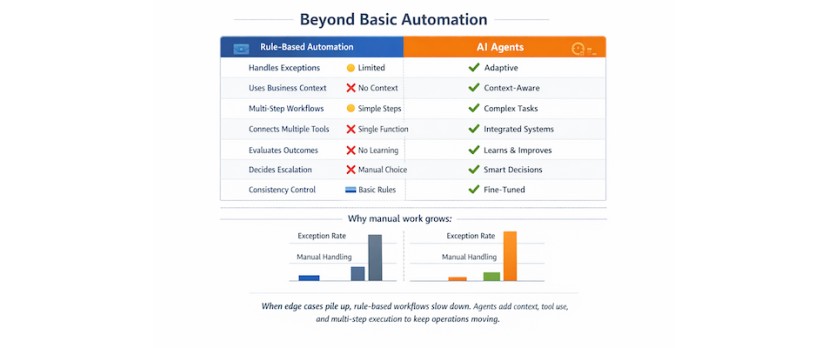
The Limits of Rule-Based Automation in Online Stores
Most eCommerce platforms rely on predefined rules:
send confirmation emails after purchase
update inventory after checkout
trigger marketing campaigns based on user actions
These workflows work well when scenarios are predictable. The challenge appears when operations require context or decision-making.
For example:
handling complex customer support requests
prioritising fulfilment issues
analysing multi-channel sales patterns
deciding when and how to escalate problems
Rule-based systems cannot easily adapt to changing conditions. As a result, teams often end up manually managing exceptions - slowing down operations.
What AI Agents Bring to eCommerce
AI agents differ from traditional automation because they can reason about tasks, select tools, and adjust their actions based on results.
Instead of executing a single instruction, an AI agent can:
analyse incoming data
decide what action is required
interact with multiple systems
evaluate outcomes and continue the workflow
For online stores, this means automation moves from simple triggers toward intelligent execution.
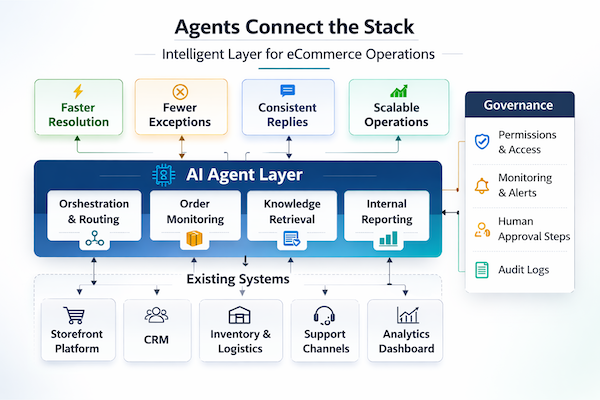
Businesses increasingly explore AI agent development to create systems capable of managing operational workflows such as customer communication routing, order monitoring, and internal reporting processes. AI agent development
Why Generic AI Models Often Fail in Commerce Workflows
Many merchants experiment with AI tools only to discover inconsistent results. Generic models often lack understanding of business-specific terminology, product structures, or customer behaviour patterns.
In eCommerce, accuracy matters:
incorrect product recommendations can reduce trust
inconsistent customer replies create friction
poor data interpretation leads to wrong decisions
This is why model adaptation becomes essential. Approaches like fine-tuning and retrieval-based systems allow businesses to align AI outputs with internal knowledge and real operational logic.
Companies adopting LLM customization can significantly improve output consistency and reduce errors by tailoring models to their own data and workflows. LLM customization
AI Agents as an Operational Layer for eCommerce Platforms
The most effective implementations do not replace existing systems. Instead, AI agents act as a layer connecting different parts of the business:
storefront platforms
CRM systems
inventory and logistics tools
customer support channels
analytics dashboards
This architecture allows merchants to scale operations without constantly increasing manual workload.
Platforms focused on enterprise AI adoption increasingly position agent-based systems as infrastructure that enhances existing digital ecosystems rather than replacing them. Nextigent AI
Practical Use Cases for Online Merchants
AI agents are already being applied to several practical eCommerce scenarios:
Customer support orchestration
Routing requests, summarising conversations, and escalating complex cases.
Order monitoring
Detecting delays or anomalies and notifying teams automatically.
Knowledge management
Helping support agents access accurate product and policy information quickly.
Internal analytics assistance
Preparing reports and highlighting unusual performance patterns.
These use cases demonstrate that AI agents are less about replacing teams and more about reducing operational friction.
What Merchants Should Consider Before Adoption
Before integrating AI agents, businesses should evaluate:
data quality and access permissions
system integrations across tools
monitoring and governance mechanisms
clear boundaries for autonomous actions
Starting with focused workflows usually produces better results than attempting full automation from the beginning.
Final Thoughts
eCommerce businesses are entering a new phase where automation alone is no longer sufficient. AI agents introduce a more adaptive approach - one that combines intelligence, execution, and continuous optimisation.
For merchants looking to scale efficiently, the opportunity lies not just in adopting AI tools but in building systems that can operate intelligently across their entire digital ecosystem.
As competition increases, the ability to automate complex workflows while maintaining quality and consistency may become a key differentiator for online stores of all sizes.



Login and write down your comment.
Login my OpenCart Account