Modern customers tend to have transaction anxiety. Shopping experience over the internet often shifts into a situation where the stakes are high for the shopper. Especially when the customer receives an email notification from an eCommerce brand in their inbox with a subject line such as 'delayed shipping,' 'refund processed,' or 'payment failed,' it creates anxiety.
It is these times when the customers experience a state of immediate response that cyber criminals make use of, or bypass critical processes. Nevertheless, being an eCommerce brand, it is upon your email message to prove that you are legitimate. Your customers can learn to trust your brand easily by using the visual indicators of a sender when they receive your emails.
The mailbox providers have visual indicators, such as Verified Mark Certificate (VMCs) which allow them to show a verified brand logo beside your brand name in the email. But what does VMC do that, and what are the particular situations you can apply it to?
This article can make you learn about the mechanics of eCommerce fraud and how trusted sender signals, such as VMCs, can assist you in preventing it.
Why eCommerce Email Fraud Works (and Why It’s So Hard to Spot)
Email fraud in eCommerce is usually successful because it exploits customers' vulnerabilities, urgency, and trust. The hackers make use of advanced methods that include malicious code injections and social engineering methods.
The trend of online shopping is increasing, and cyberattackers turn to further methods such as deepfakes, which are developed using AI. In fact, there is a high volume of scam patterns that attackers use.
Some of these patterns are,
Fake Order Updates: These scams exploit the post-purchase window by sending false alerts about delivery exceptions or requests to “confirm address,” triggering immediate concern from the recipient.
Payment “Re-confirmation”: Attackers pose as billing departments requesting bank or UPI change requests to process a supposed refund.
Account Alerts and Password Reset Lures: These emails mimic security warnings, prompting users to click malicious links to "secure" their accounts.
“Support Ticket” Impersonation: Scammers insert themselves into the chargeback or return process, impersonating agents to divert funds or harvest credentials.
Why Do These Scams Convert?
Attackers are successful because they exploit the standard behaviors and technical limitations of email communication:
Transactional Emails Are Time- Bounded: When the users are trained to move quickly on the transactional updates, chances of their careful examination are minimized.
Sender Display Names Can be Easily Spoofed: The display name can be easily spoofed, although the email address itself may be wrong, and tricks of reply-to can be used to send traffic to the wrong recipient.
Signatures Can Be Replicated: It is publicly accessible, and the attacker can produce aesthetically valid emails.
Attackers often become successful in implementing the eCommerce attacks through different patterns. However, verified sender indicators can help you reduce such scams.
What Verified Sender Indicators Are (and What Customers Actually Notice)
Verified Sender Indicator is a visual cue or visible inbox-level signal to authenticate the sender’s identity and ensure it's approved to be displayed. It’s different from backend protocols that simply allow an email to be delivered. A verified sender indicator is also a front-end element that helps the recipient with the confirmation of the sender’s identity and authenticity.
What Users Notice in Real Inbox Behavior?
When users are scanning their inbox, customers often look at specific proof for brand authenticity,
For example, customers look at,
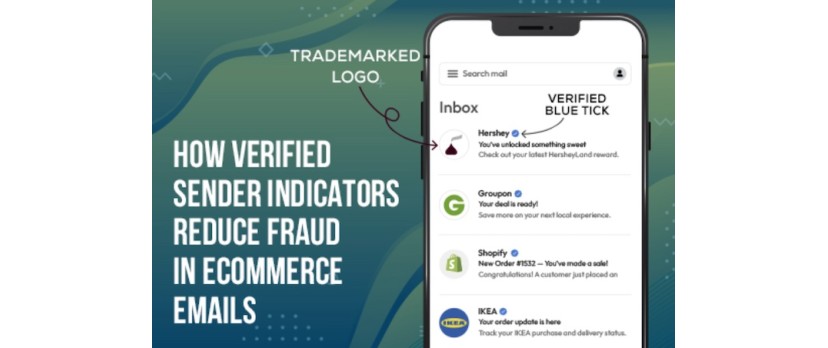
Verified markers supported by email clients like Gmail or Apple Mail. This can be an icon like the blue check mark or others that confirm if the domain is vetted.
Verified brand logo displayed in the email message instead of a generic letter like “B” for “Brand.”
Consistent brand identity through logos and sender name appearing uniformly across the email clients and platforms.
However, it is important to understand that verified sender indicators are different from the approach where you set up SPF/DKIM/DMARC. Most of these protocols are not visible indicators. They operate behind the scenes.
It is also not the same as a profile photo. Any user can upload a profile picture that looks like the sender. On the contrary, a verified sender indicator will need a verified mark certificate or VMC, which is not possible for a scammer to upload.
With verified sender indicators, customers can easily make decisions on whether to trust an email from the brand. In an environment where users rely on visual cues for trust, a verified logo or badge becomes crucial, and this is where VMC helps.
How Verified Mark Certificates (VMC) Power Verified Sender Indicators
A verified Mark Certificate or VMC is a digital certificate that mailbox providers use to display a verified brand logo in the customer’s inbox. It provides a cryptographic proof of the organization’s authenticity for users.
Why does this matter for fraud reduction?
Verification is tied to the domain and identity: VMC binds a registered logo cryptographically to the specific authenticated domain. This creates a verified identity validated by the infrastructure rather than the recipient.
Attackers cannot easily replicate the display: Replicating a brand’s verified logo is complex for any attacker compared to the content font and colors. So, using a VMC makes sense.
Prerequisites for VMC Certificate
DMARC Enforcement: If you want to qualify your brand logo for a VMC, the domain must have established a DMARC policy. You need to set DMARC to strict enforcement levels (p = quarantine or p= reject). To reach this level without risking your email deliverability, many brands use DMARKOFF by GlockApps to carefully monitor their traffic and move to a strict policy safely.
Brand and Logo Validation: Your organization requires a registered trademark for the brand logo in a recognized jurisdiction and submits to identity verification by a certificate authority.
Verification is strongest when it is applied consistently across all of a brand’s sending domains and email streams, spanning both marketing and transactional communications. If a customer is trained to see a verified logo, the absence of that logo on critical transactional messages creates a "security friction" that acts as an immediate warning sign of potential fraud.
How Verified Sender Indicators Reduce Fraud in Real eCommerce Scenarios
Email marketing has an ROI of up to 36 times that of other channels. So, you need to ensure minimal fraud and damage to your brand reputation. And this is where verified sender indicators like VMC can help. They offer clear visual cues for your customers, ensuring your emails create an impact for which the campaigns are intended.
Let’s understand how verified sender indicators reduce fraud in specific eCommerce scenarios,
Fake Shipping and Delivery Exception Emails
Suppose you consider a standard shipping scam where a customer receives an email regarding the delivery of their product. The email states that the delivery was unsuccessful due to the wrong address and has a link for the customer to confirm the address.
This link is a social engineering tool that allows attackers to execute the attack. However, such emails often don’t have the official logo and checkmark. This acts as a visual discrepancy, instilling a cognitive alert in the customer.
Refund/payment rerouting and “update your payout method” scams
Attackers often exploit a panicked customer or instill a sense of urgency during a scenario of failed refunds. Here, the brand’s verified logo is crucial. It allows customers to segregate scam emails from the legitimate ones.
Account takeover/password reset traps
Trusting resets only when verified: Account takeovers often start with fake "unauthorized login" alerts. By consistently verifying transactional streams, brands train customers to trust password resets only when the trademarked logo is visible. Since attackers cannot replicate the cryptographic proof required for the logo, the legitimate reset email remains visually distinct from the spoofed version.
Customer support impersonation
Fraudsters often pose as support agents to gain remote access or resolve fake chargebacks. Verified indicators strip attackers of their "fake badge" authority, allowing customers to distinguish legitimate support outreach from lookalike attempts via a binary, inbox-level signal.
Why does this beat warnings and training alone?
Traditional training fails because users often neglect safety rules when rushed or anxious, and AI tools have eliminated the typos users were taught to spot. Verified indicators shift the burden of trust from "user judgment" to "inbox-level identity signals," providing a split-second confirmation of authenticity that does not rely on the recipient's forensic skills.
While training may only marginally reduce click rates, verified indicators have been shown to increase consumer confidence in legitimacy by 90%.
Limits of Verified Indicators
Verified indicators cannot prevent fraud sent from a compromised legitimate account or insider threats, as those emails are technically authenticated by the brand's own server. Verification must be complemented by continuous monitoring of DMARC reports to identify anomalies and active brand protection processes to take down lookalike domains that may still deceive users outside of the email environment.
Conclusion
The change in cyber attacks is fast, and the eCommerce business owners require more than the standard security protocols in order to get the confidence of the customers. As more individuals adopt AI-based deepfakes, the visuals will be essential to your eCommerce company.
A verified mark certificate offers visual cues for customers, helping them identify your brand. It blends your verified brand logo with cryptography and ensures your emails have a verified sender’s indicator that customers trust. So, prioritize visual trust signals today and ensure customer trust for your brand.



Login and write down your comment.
Login my OpenCart Account