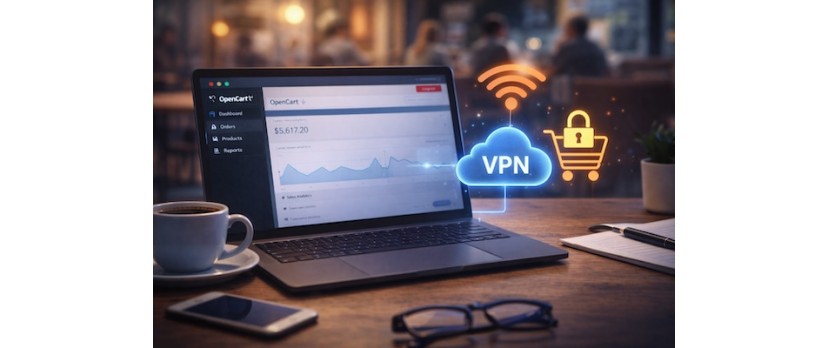
Running an online store today rarely happens from just one desk.
You check orders from your laptop at home. Update product listings during lunch. Reply to customers from a café. Review analytics while traveling. Approve refunds from a hotel room before a flight.
Ecommerce is mobile.
But while store owners spend time securing their websites SSL certificates, payment gateways, two-factor authentication they often overlook something much simpler:
The network they’re using to access their store.
Store Security Doesn’t End at the Server
If you run an OpenCart store, you likely take backend security seriously.
You protect your admin panel. You update plugins. You monitor transactions. You secure payment processing. You rely on HTTPS encryption.
All of that protects your customers.
But what protects the connection between your laptop and your store dashboard when you log in from public Wi-Fi?
That’s a different layer.
Even when your website uses SSL, the network you connect through can still see certain metadata — including your IP address and connection timing. Public Wi-Fi networks in airports, coworking spaces, and cafés are shared environments. They prioritize convenience, not business security.
That doesn’t mean someone is actively targeting you.
But if your store is your income, even small risks deserve attention.
Ecommerce Work Happens Everywhere
Many online sellers don’t operate from a single office.
They:
Manage orders from coffee shops
Update pricing while traveling
Coordinate with suppliers remotely
Access cloud dashboards on shared networks
Handle customer support on hotel Wi-Fi
In these moments, you’re logging into your store’s admin area often with elevated permissions.
If that login session travels through a public hotspot without additional protection, your exposure increases.

That’s why many small business owners choose to use a best vpn when managing store operations outside their home or office network.
A VPN encrypts your internet traffic before it leaves your device. Instead of sending your admin session directly through the local router, it creates a secure tunnel to another server. That extra layer reduces what the shared network can observe about your activity.
It doesn’t replace website security.
It complements it.
Protecting the Admin Side of Your Business
When you think about risk, most store owners focus on customer-facing threats fraud, chargebacks, bot traffic.
But your admin panel is equally critical.
If your login credentials are compromised, someone could:
Change product pricing
Access customer records
Modify payment settings
Redirect transactions
Lock you out of your own store
Most of the time, strong passwords and two-factor authentication prevent direct attacks.
But secure credentials don’t control the network path your data travels through.
Layered protection is stronger than single-point protection.
Why Windows Users Should Pay Attention
Many ecommerce operators manage their stores from Windows laptops.
Whether it’s inventory spreadsheets, accounting tools, analytics dashboards, or bulk product uploads, Windows remains common in small business environments.
When those laptops connect to public Wi-Fi, they carry access to:
Store dashboards
Payment processors
Supplier portals
Business email
Cloud storage
Using a VPN on Windows adds network-level encryption to that workflow.
Solutions like X-VPN are available through the Microsoft Store, offering both free and premium options for users who want quick setup without complicated configuration.
The goal isn’t to turn store owners into security experts.
It’s to make protection practical.
The Reality of Modern Store Management
Ecommerce doesn’t operate from one fixed location anymore.
You might check overnight sales before breakfast. Approve refunds while waiting at the airport. Adjust inventory numbers from a coworking space. Review supplier invoices from a hotel room.
Your store travels with you.
That flexibility is powerful.
But mobility also increases reliance on networks you don’t control.
Public Wi-Fi networks are designed for accessibility. They are shared by dozens sometimes hundreds of users at once. They aren’t configured with your store’s backend security in mind.
Taking one extra step to encrypt your connection when working remotely isn’t dramatic.
It’s responsible.
Security as a Business Habit
Store owners understand risk management.
You insure shipments. You verify suppliers. You monitor transactions. You audit expenses.
Adding a VPN when accessing your store outside your secured home or office network fits into that same mindset.
It’s not about assuming the worst.
It’s about reducing avoidable exposure.
Strong ecommerce security combines:
Secure hosting
Regular updates
Two-factor authentication
Backup systems
Network encryption when working remotely
No single measure is perfect.
But together, they create resilience.
Your Store Is an Asset — Treat It Like One
For many entrepreneurs, an OpenCart store isn’t just a side project.
It’s income. Growth. Independence.
You already protect it at the server level.
Make sure you’re protecting the connection you use to manage it as well.
Because in today’s flexible work environment, security doesn’t stop at your website.
It follows you wherever you log in.



Login and write down your comment.
Login my OpenCart Account